
A salesperson walked into your building with a spreadsheet. The spreadsheet said 14-month payback. The spreadsheet was probably wrong, and not because the salesperson lied.
Most commercial LED lighting retrofit proposals are built by lighting distributors who model the lamps and quietly assume everything else. They assume the existing fixtures accept a retrofit kit. They assume the ballasts come out clean. They assume the circuits and controls stay untouched. They assume a rebate that may not exist in Ohio anymore. Then an electrician opens the first fixture, finds a 1987 ballast wired through a switch leg with no neutral, and the timeline and the number both move.
At ANR Electric, we do this work as electrical contractors rather than lamp sellers, across warehouses, manufacturing floors, offices, and retail sites throughout Northeast Ohio. What follows is the version of the math that survives contact with an actual ceiling.
Why a Commercial LED Lighting Retrofit Still Pencils in 2026
The easy wins are gone, and the case for a commercial LED lighting retrofit is still strong. Here is why.
Lighting is one of the few building loads you can cut by half without changing how anyone works. Swap a 400-watt metal halide high bay for a 150-watt LED high bay and you have removed 250 watts from a fixture that runs 4,000 hours a year. Multiply by 80 fixtures in a warehouse and you are looking at 80,000 kilowatt-hours a year.
At the U.S. Energy Information Administration’s reported average Ohio commercial electricity rate of 10.66 cents per kilowatt-hour, that is roughly $8,500 a year. And that rate is the 2024 baseline. Ohio commercial rates have climbed since, which makes the savings side of every retrofit model larger this year than it was two years ago.
Typical energy reduction by what you are replacing:
| Existing technology | Typical LED energy reduction |
|---|---|
| Metal halide or high pressure sodium high bay | 50 to 70 percent |
| T12 fluorescent | 55 to 65 percent |
| T8 fluorescent | 35 to 50 percent |
| Incandescent or halogen accent | 75 to 85 percent |
| Exterior HID pole and wall pack | 55 to 75 percent |
Add lighting controls, occupancy sensing, and daylight harvesting, and another 20 to 40 percent comes off in spaces that are not continuously occupied. Warehouse aisles, storage rooms, restrooms, and stairwells are where controls earn their money.
Then there is the line nobody puts on the spreadsheet: maintenance. A 40-foot ceiling in a warehouse means a lift, two people, and a shutdown window every time a lamp fails. Commercial LED product life is typically rated at 50,000 to 100,000 hours. Removing lamp replacement from a facility manager’s calendar is frequently worth more than the kilowatt-hours, and it never shows up in the distributor’s model.
The market has already moved. The EIA’s Commercial Buildings Energy Consumption Survey found that more than 2.5 million commercial buildings used LED lighting, five times the number that did in 2012. If your building is still on HID or T12, you are now the outlier.
What a Commercial LED Lighting Retrofit Actually Costs
Commercial LED lighting retrofit cost is driven by fixture type, mounting height, and how much electrical work hides behind the lens. Rough installed ranges for Northeast Ohio:
| Fixture type | Installed cost per fixture |
|---|---|
| 2×4 troffer, retrofit kit into existing housing | $95 to $180 |
| 2×4 troffer, full fixture replacement | $180 to $340 |
| Warehouse high bay, 100 to 240 watt LED | $300 to $650 |
| Exterior wall pack | $250 to $500 |
| Parking lot pole head | $500 to $1,400 |
| Occupancy or daylight sensor, installed | $120 to $300 |
| Networked lighting control system | Quoted by zone, not by fixture |
Three variables move these numbers more than anything else:
- Mounting height and access. Everything above 20 feet needs a lift. Everything over racking needs a lift and a coordination plan with the warehouse manager.
- After-hours work. Retail and food service almost always require night or weekend installation. Budget a premium.
- What is behind the fixture. This is the real one, and it is the section most proposals skip.
The Commercial LED Lighting Retrofit Scope Vendors Leave Out
Here is where a commercial LED lighting retrofit turns from a product purchase into an electrical project.
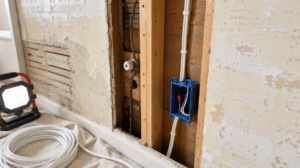
Ballast bypass and existing wiring. A retrofit kit that requires ballast bypass means someone is working inside every fixture, cutting and capping ballast leads and rewiring to line voltage. In buildings with aging conductors, brittle insulation, or original fixture whips, that work is slower and occasionally turns into replacement.
Missing neutrals. Modern lighting controls and many LED drivers require a neutral at the switch. Older commercial buildings frequently ran switch legs without one. Adding neutrals means fishing conductors or running new raceway, and it is one of the most common reasons a controls scope balloons after the fact.
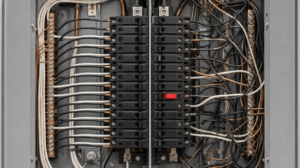
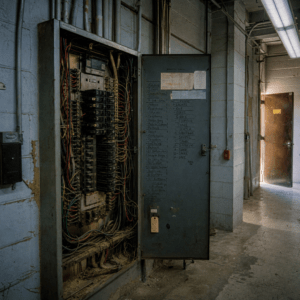
Circuit loading and panel space. Cutting connected load is generally good news. But a controls retrofit that adds relay panels, powered sensors, or a networked lighting control system can need new circuits and panel space that is not there. Our post on signs a commercial building’s electrical system needs an upgrade covers when that becomes the real project.
Emergency and egress lighting. Retrofitting a fixture that serves as emergency egress lighting brings life-safety requirements into scope, including battery backup or generator-fed circuits and inverter compatibility. This is not a place for improvisation.
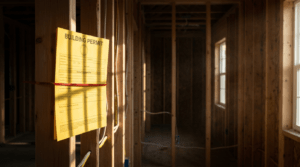
Code compliance. Ohio’s commercial construction follows the Ohio Building Code, and lighting projects of meaningful scope generally require an electrical permit and inspection through the local building authority. In Akron, that is the Summit County Department of Building Standards, which provides commercial plan review and inspection for 23 jurisdictions.
Photometrics. Watts are not light. Replacing a 400W metal halide with an underspecified LED can leave a warehouse aisle at half the foot-candles it needs, and you will hear about it from the people working under it within a week. A proper commercial LED lighting retrofit includes a photometric layout, not just a wattage swap.
The Ohio Rebate Reality
Every LED vendor’s proposal has a rebate line. In Ohio you should treat that line skeptically until it is confirmed in writing.
Ohio gutted its statewide energy efficiency resource standard through House Bill 6 in 2019. According to the ACEEE state policy database for Ohio, a February 2020 regulatory order directed utilities to stop accepting applications for residential and non-residential efficiency rebate programs by September 30, 2020, and most utility efficiency programs were discontinued as of December 31, 2020. Ohio now scores 1 out of 29 possible points in ACEEE’s utilities category.
FirstEnergy’s Ohio utilities, which include Ohio Edison serving the Akron area, have run a Commercial Lighting Initiative offering incentives for high-efficiency lighting and controls in existing facilities and new construction. Availability and funding have moved repeatedly. Treat any rebate as unconfirmed until you have it in writing.
What to actually do:
- Check energysaveOhio.com for current FirstEnergy program status before you build a rebate into your model
- Get any incentive pre-approved in writing before purchasing equipment, since most programs require pre-approval and reject retroactive applications
- Confirm the fixtures on your bill of materials appear on the program’s qualified products list, because “LED” is not a qualification
- Model your payback with and without the rebate. If the project only works with the incentive, it is not a project, it is a bet
The honest framing: a commercial LED lighting retrofit in Ohio should stand on energy and maintenance savings alone. A rebate should be upside, not the foundation.
Running the Commercial LED Lighting Retrofit Payback Math Yourself
You do not need a vendor to model a commercial LED lighting retrofit. You need four numbers.
The formula:
Annual savings = (existing watts – new watts) ÷ 1,000 × annual operating hours × your $/kWh
Simple payback in years = total installed project cost ÷ annual savings
Worked example, a 60,000 square foot Akron warehouse:
- 90 existing 400W metal halide high bays, drawing about 458W each with ballast losses
- Replaced with 150W LED high bays
- Operating 4,160 hours a year, two shifts, five days a week
- Rate of 10.66 cents per kilowatt-hour
Energy saved: (458 – 150) ÷ 1,000 × 4,160 × 90 = 115,315 kWh per year
Annual energy savings: 115,315 × $0.1066 = $12,293
Installed project cost at $475 per fixture: $42,750
Simple payback: 42,750 ÷ 12,293 = 3.5 years
Now add the two things the simple model misses. Occupancy sensors in low-traffic aisles cut another 15 to 25 percent of runtime, which pulls payback under three years. Eliminating roughly $2,500 a year in lift rental and relamping labor pulls it closer to two and a half.
Also worth pricing: what happens to the model if Ohio commercial rates keep climbing. Every rate increase shortens your payback, which is an unusual position to be in as a facility manager.
How to Scope a Commercial LED Lighting Retrofit So It Does Not Surprise You
Six steps, in order. Skipping step two is the most common and most expensive mistake.
- Audit the existing inventory. Count fixtures by type, lamp, wattage, mounting height, and circuit. Note which are on switches, which are on contactors, and which are always on.
- Open three fixtures. Physically. One of each type. This is where you find the bypassed ballast, the missing neutral, the brittle whip, and the surprise. Any contractor unwilling to do this is quoting from a photograph.
- Get a photometric layout. Target foot-candles by task area, not by wattage equivalence.
- Decide the controls strategy before selecting fixtures. Retrofitting controls onto fixtures chosen without controls in mind is how projects get done twice.
- Confirm incentives in writing, with pre-approval.
- Plan the phasing and the shutdown windows. In a production environment the lighting is rarely the constraint. The schedule is.
Frequently Asked Questions
How much does a commercial LED lighting retrofit cost?
Installed cost typically runs $95 to $180 per 2×4 troffer using a retrofit kit, $180 to $340 for full troffer replacement, and $300 to $650 per warehouse high bay. Exterior pole heads run $500 to $1,400. Total project cost depends heavily on mounting height, lift requirements, after-hours labor, and what condition the existing wiring is in.
What is a typical payback period for an LED retrofit?
Most commercial projects land between two and five years on simple payback. High-hour facilities like warehouses, manufacturing plants, and 24-hour operations reach the low end. Offices running single-shift hours land higher. Adding occupancy and daylight controls, and counting avoided relamping labor, typically pulls payback down by six to eighteen months.
Are there LED rebates available in Ohio?
Far fewer than most vendors imply. Ohio gutted its efficiency standard through House Bill 6, and per ACEEE most utility rebate programs were discontinued as of December 31, 2020. FirstEnergy’s Ohio utilities have run a Commercial Lighting Initiative at times, but availability has moved repeatedly. Verify current status directly and get written pre-approval before purchasing equipment.
Do I need a permit for a commercial LED lighting retrofit?
Usually yes for anything beyond simple lamp replacement. Ballast bypass, fixture replacement, new circuits, and controls installation are electrical alterations subject to the Ohio Building Code. In Akron, commercial electrical permits are issued by the Summit County Department of Building Standards. Confirm requirements with your local building authority before work begins.
Can I just put LED lamps in my existing fixtures?
Sometimes, and it is often a false economy. Plug-and-play LED tubes that run on the existing ballast are the least disruptive option, but you keep paying ballast losses and you inherit the ballast’s remaining lifespan. Ballast bypass or full fixture replacement delivers materially better efficiency, longer life, and full compatibility with modern controls.
Will LED lighting reduce my building’s peak demand charges?
It can. Lighting runs during business hours, which for most commercial accounts overlaps directly with the peak demand window that sets your demand charge. Cutting connected lighting load reduces peak kilowatt draw. The size of the effect depends on your rate structure and how large lighting is relative to your HVAC and process loads.
Get the Fixtures Opened Before You Get the Proposal
The difference between a commercial LED lighting retrofit that hits its number and one that does not is almost always found behind the lens, in the ballast leads, the missing neutral, and the circuit nobody traced.
ANR Electric has served manufacturing, warehouse, retail, and office facilities across Northeast Ohio since 2011. We audit the existing system, open the fixtures, run the photometrics, price the electrical work that lighting vendors leave out, and give you a payback model that holds up after the first day of installation.
Schedule a facility lighting assessment
Or call (330) 644-4454 to talk with an electrician instead of a lamp salesperson. We serve commercial and industrial clients in Akron, Green, Hudson, Fairlawn, Macedonia, Richfield, Kent, Canton, Medina, Wooster, and Alliance. Explore our commercial electrical services and industrial electrical services.