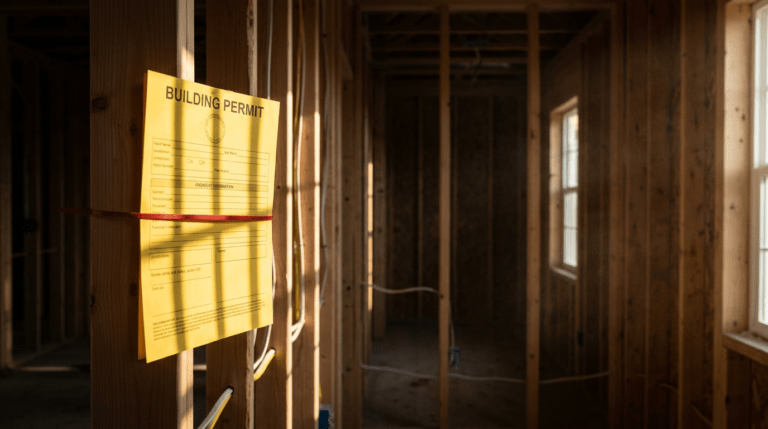
Here is the fastest way to waste an afternoon in Summit County: call the City of Akron to ask about an electrical permit.
They will be polite. They will also tell you they do not issue an electrical permit. Akron handles sewer permits, grading permits, right-of-way permits, pool permits, and razing permits. Electrical is not on the list. If you need an electrical permit in Akron, you are dealing with a different agency entirely, in a building most homeowners have never heard of.
At ANR Electric, we pull these permits every week, and the confusion around them is easily the most common non-technical question we get. So this is the plain-English version: who issues the permit, what work needs one, what drives the cost, how long it takes, whether you can pull it yourself, and what actually goes wrong when people skip it.
Who Issues an Electrical Permit in Akron?
The Summit County Department of Building Standards. Not the city.
Here is the full contact block, because it is the thing most people are actually looking for when they search this:
Summit County Department of Building Standards
1030 East Tallmadge Avenue, Akron, OH 44310
Phone: (330) 630-7280
Office hours: Monday through Friday, 7:30 a.m. to 4:00 p.m.
Inspection hours: Monday through Friday, 8:00 a.m. to 3:00 p.m.
Summit County Building Standards provides residential plan review and inspection services for 22 jurisdictions and commercial services for 23 jurisdictions across the county. Akron is one of them. You can confirm this directly on the City of Akron Plans and Permits page, which states that Summit County reviews and issues permits for projects covered under the Ohio Building Code and Ohio Residential Code.
One wrinkle worth knowing: for projects inside Akron city limits, submissions generally go to both Summit County and the City of Akron, because the city still reviews certain aspects even when the county issues the trade permit. That dual-submission requirement is a common source of delay when a homeowner tries to navigate it alone.
If you are outside Akron, check first. Some Summit County municipalities have their own building departments and do not use the county for residential review. Barberton, Cuyahoga Falls, and Stow have historically run their own operations at various times. The Summit County Building Standards page lists current jurisdictions, and calling the county is the fastest way to confirm which office covers your address.
What Electrical Work Requires an Electrical Permit?
The general rule in Ohio: new circuits, altered circuits, and anything touching the service require a permit. Direct like-for-like replacement of a device usually does not.
Here is how that electrical permit rule plays out in practice.
Requires an electrical permit in Akron:
- Panel replacement or service upgrade of any kind
- Adding any new branch circuit
- EV charger installation
- Hot tub or spa circuits
- Generator installation and transfer switch work
- Whole-home or partial rewiring
- Finished basement, attic conversion, or addition wiring
- New outdoor circuits, landscape lighting on a new circuit, or detached garage feeds
- Kitchen or bathroom remodels that move or add receptacles
- Meter base replacement or relocation
- Anything involving the service entrance conductors or grounding electrode system
Generally does not require an electrical permit:
- Replacing a light fixture on an existing circuit
- Replacing a switch or receptacle with a like device
- Replacing a breaker with an identical breaker
- Changing a ceiling fan for a ceiling fan
- Replacing a thermostat
The gray area, and how to resolve it: if the work changes the load, the circuit, or the wiring method, assume you need an electrical permit. If you are only swapping a device that was already there, you generally do not. When you are genuinely unsure, one phone call to (330) 630-7280 costs nothing and takes four minutes. Guessing wrong costs considerably more.
Worth noting: replacing a standard receptacle with a GFCI receptacle in a location where GFCI is now required is usually treated as a device replacement, not new work. Our guide to GFCI outlet requirements for Akron homeowners covers where those are mandated.
What Determines the Cost of an Electrical Permit in Akron
Summit County sets its own fee schedule and revises it periodically, so the honest answer to “what will it cost” is that it depends on the job. Here is what actually moves the number.
What the county charges depends on:
- The type of work. New construction, alteration, and straight repair or replacement are priced differently from one another.
- The size of the area involved. Several categories scale with square footage, so a single new circuit and a whole-floor rewire are not the same filing.
- Whether plan review is required. Larger residential projects and most commercial work carry review beyond a straightforward filing.
- Whether a reinspection is needed. A failed inspection means going back, and that costs both a fee and a place in the schedule.
What a contractor’s permit line actually covers. The county fee is only one part of it. When ANR Electric pulls an electrical permit for you, that line also covers preparing the application, drafting the overhead or underground service diagrams the county requires, filing and tracking the permit, scheduling around the inspector’s window, being on site to meet them, and submitting the power turn-on request afterward. That administrative work is real time, and it is the difference between an electrical permit that moves and one that sits.
The part worth remembering. Relative to the electrical work itself, permitting is rarely what makes a project expensive. What it does is make the work defensible later, at closing, with your insurer, and with the next person who opens that panel. For current fee amounts on your specific project, call the county directly or ask your contractor to break the permit line out on the quote.
Can a Homeowner Pull Their Own Electrical Permit?
In Summit County, yes, with conditions.
A homeowner can pull a permit for work on a home that is in their own name, and they must sign a notarized Homeowner’s Affidavit. Gas line work is excluded. The Summit County residential forms page hosts the Homeowner’s Affidavit alongside the Electrical Permit Application, the Overhead Electrical Service Diagram, the Underground Service Diagram, and the Power Turn On Request form.
So the legal answer is yes. The practical answer deserves more nuance.
Pulling your own electrical permit in Akron means you personally own the code compliance. The inspector is measuring your work against the 2023 National Electrical Code, which Ohio incorporates through the Ohio Residential Code. That is a document with thousands of requirements covering conductor sizing, box fill, AFCI and GFCI protection, working clearances, grounding, bonding, and labeling. A failed inspection means the work comes back out, sometimes out of a wall you already closed.
It also creates a disclosure question later. When you sell, the permit record shows who did the work. A buyer’s inspector who finds homeowner-permitted service work tends to look harder at everything else.
Rewiring a bedroom outlet is one thing. Panel work, service work, and anything involving 240 volts at high amperage is a different risk category. Our post on whether the wiring in your Akron home is actually safe covers what tends to go wrong in DIY work.
The Electrical Permit Inspection Process, Step by Step
Once the electrical permit is issued, here is the sequence.
- Electrical permit issued. Straightforward residential electrical permits are commonly processed in a few business days. Commercial and plan-review work takes longer.
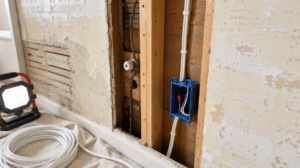
- Rough-in inspection. Before insulation and drywall go up, the inspector verifies boxes, conductor routing, staples, box fill, and grounding. Everything is open and visible. Do not close the walls before this happens. This is the single most expensive mistake in the whole process.
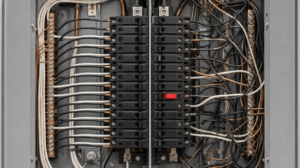
- Service or panel inspection. On panel and service work, the inspector verifies the panel, breakers, grounding electrode system, bonding, surge protection, and labeling.
- Final inspection. Devices installed, covers on, fixtures hung, panel directory filled out.
- Power turn-on authorization. On service work, the county authorizes the utility to reconnect after passing.
Inspections are requested online through the county’s Cityworks portal at cityworks.summitoh.net or by phone. The daily inspection schedule and results are published at permitsearch.summitoh.net, which is also where you can look up permit history on a property, useful if you are buying a house and want to see what was permitted.
Inspections run Monday through Friday, 8:00 a.m. to 3:00 p.m.
What Actually Happens If You Skip the Electrical Permit
Nobody from the county is driving past your house looking in windows. The consequences of unpermitted electrical work almost never arrive on the day of the work. They arrive later, at the worst possible moment.
At closing. This is where it usually surfaces. A buyer’s home inspector flags a panel, a circuit, or a subpanel. The buyer’s agent asks for the permit. There is no permit. Now you are negotiating a repair credit under time pressure, or paying for a retroactive permit and inspection on finished walls. Our post on electrical issues that kill home sales in Akron covers what inspectors flag most.
With your insurer. If a fire originates in unpermitted work, expect the carrier to investigate the work’s status. Coverage outcomes vary by policy and circumstance, which is precisely the problem: you do not want your claim to be the interesting one.
With the county. Work discovered without a permit can require a retroactive permit, opening of finished surfaces for inspection, and correction of anything not compliant.
Warranty and equipment. Manufacturer warranties on chargers, generators, and equipment frequently require professional installation and permitted work.
An electrical permit is a small line on a project. Everything on that list costs more.
Frequently Asked Questions
Who issues an electrical permit in Akron, Ohio?
The Summit County Department of Building Standards issues electrical permits for Akron, not the City of Akron. The office is at 1030 East Tallmadge Avenue, Akron, OH 44310, and the phone number is (330) 630-7280. Summit County provides residential plan review and inspection for 22 jurisdictions and commercial services for 23 across the county.
What determines the cost of an electrical permit in Akron?
Summit County sets the fee, and it varies with the type of work, the square footage involved, and whether plan review is required. A contractor’s permit line normally covers more than the county fee alone, since it also includes preparing the application, the required service diagrams, filing, scheduling, and being on site to meet the inspector. Ask for it itemized on your quote.
Do I need a permit to replace an outlet or light fixture?
Generally no. Replacing an existing receptacle, switch, or light fixture with a like device on an existing circuit is treated as maintenance and does not typically require a permit. Adding a new receptacle, moving one, or running a new circuit does require an electrical permit and an inspection.
Can a homeowner pull an electrical permit in Summit County?
Yes. A homeowner may pull a permit for work on a home held in their own name by signing a notarized Homeowner’s Affidavit, available on the Summit County Building Standards residential forms page. Gas line work is excluded. The homeowner is then responsible for passing inspection against the 2023 National Electrical Code.
How long does it take to get an electrical permit in Akron?
Straightforward residential electrical permits are commonly issued within a few business days of a complete application. Projects requiring plan review, and most commercial work, take longer. Inspections are scheduled separately and are conducted Monday through Friday between 8:00 a.m. and 3:00 p.m.
What happens if electrical work was done without a permit?
The county can require a retroactive permit and inspection, which may mean opening finished walls so the work can be verified. Unpermitted work also commonly surfaces during a home sale, where it becomes a negotiating point, and it can complicate an insurance claim if a loss originates in that work.
Does my electrician pull the permit, or do I?
A licensed electrical contractor should pull the permit as part of the job, and the cost is normally built into the quote. If a contractor asks you to pull the permit yourself as the homeowner, treat it as a warning sign. It shifts code responsibility onto you and can indicate the contractor is not properly licensed or registered.
Let Someone Else Handle the Paperwork
Pulling an electrical permit in Akron is not complicated once you know it goes through Summit County instead of the city. But between the application, the service diagrams, the affidavit, the inspection scheduling, and the power turn-on request, it is a lot of forms for a Saturday project.
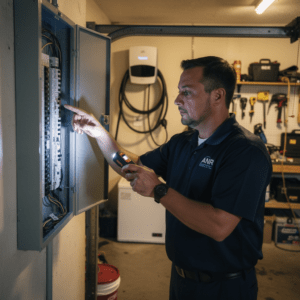
ANR Electric has been wiring homes and businesses across Northeast Ohio since 2011. We pull the permit, meet the inspector, and hand you the closed-out record at the end. That record is what protects you at closing, with your insurer, and the next time somebody opens that panel.
Or call (330) 644-4454. We serve Akron, Green, Hudson, Fairlawn, Macedonia, Richfield, Kent, Canton, Medina, Wooster, and Alliance, and we handle permits and inspections on every job. See our full range of residential electrical services.