Northeast Ohio homeowners don’t need to be convinced that losing power is a real problem. If you’ve lived through a winter ice storm that knocked out FirstEnergy service for three days, or a summer storm that took your neighborhood dark for a week, you already understand what’s at stake.
The question most homeowners are sitting with isn’t whether power outages happen. It’s whether a standby generator is worth it for their specific situation – and what the process of getting one actually looks like.
This guide is built around that decision. We’ll walk you through how standby generators work, what makes them different from the portable unit in your garage, who they make the most sense for, and what your home needs to support one.
Standby vs. Portable: The Difference That Actually Matters
Most Akron homeowners who call us about generators already have a portable generator somewhere in their garage. And portable generators have their place – they’ll keep a few lights on and run the refrigerator if you’re willing to manage extension cords and fuel.
But a standby generator is a fundamentally different product. Here’s how they compare:
Portable generators:
- Require manual setup every time you need them
- Run on gasoline, which you have to store and rotate
- Need to be operated outside to avoid carbon monoxide risk
- Transfer power manually using extension cords or a manual transfer switch
- Typically power only a few circuits at a time
- Must be refueled regularly during extended outages
Standby generators:
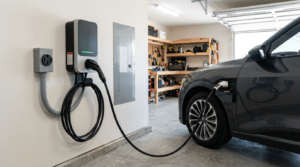
- Permanently installed outside your home, similar to a central AC unit
- Connected directly to your home’s natural gas or propane supply – no fuel runs, no storage
- Start automatically within seconds of detecting a power loss, even if you’re not home
- Powered through an automatic transfer switch that seamlessly moves your home from grid to generator power
- Can power your entire home or a pre-selected set of essential circuits
- Designed to run for days without interruption
The standby generator doesn’t ask anything of you. The power goes out, it starts. You wake up in the morning to a house that never stopped running.
Who Actually Needs a Standby Generator?
This is the honest version of the answer – not a sales pitch, but a real framework for thinking about whether the investment makes sense for your household.
A standby generator makes strong sense if:
You or someone in your home depends on medical equipment. CPAP machines, home oxygen concentrators, powered wheelchairs, refrigerated medications, and monitoring equipment are all power-dependent. For households with medical equipment, a standby generator moves from convenience to safety.
You work from home full-time. A power outage that lasts more than a few hours means lost income for remote workers. If your livelihood depends on an internet connection and a powered workstation, the math on a generator changes quickly.
You’ve lost a refrigerator or freezer full of food during a past outage. Northeast Ohio storms have a way of taking out power for three to five days at a time. Replacing a full freezer of food, twice in two years, adds up to a number that starts to look a lot like a generator payment.
Your home has a sump pump. Akron and Summit County get meaningful rainfall, and a power outage during a heavy rain event is precisely when you need your sump pump most. Flooded basements during power outages are among the most common and costly homeowner insurance claims in our area.
You have young children or elderly family members at home. Temperature extremes during an outage – winter cold or summer heat without central air – create real risk for the very young and the elderly.
A standby generator may be worth waiting on if:
Your outages are consistently short (under four hours) and infrequent. A standby generator is a long-term investment. If your neighborhood has reliable utility infrastructure and outages are rare, the cost-benefit calculation is different.
You’re still evaluating other major home investments. A generator competes with other priorities – a roof replacement, an HVAC upgrade, a panel upgrade. Make sure your home’s core systems are sound before adding a generator.
What Your Home’s Electrical System Needs First
This is the part most homeowners don’t think to ask about until they’re already talking to a contractor.
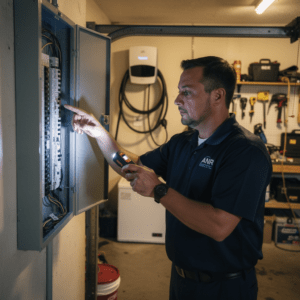
A standby generator connects to your home’s electrical system through an automatic transfer switch (ATS). The transfer switch monitors your utility power, detects an outage, signals the generator to start, and transfers your home’s load to generator power – all in seconds. When utility power is restored, it transfers back and shuts the generator down.
For this to work safely and correctly, your home needs:
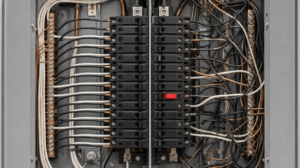
An adequately sized electrical panel.
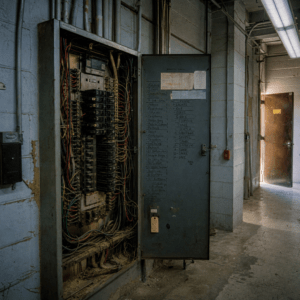
The generator is sized to supply a certain amount of power – typically matching or approximating your home’s full load. Your panel needs to be in sound condition and properly sized to work with the transfer switch. Older 100-amp panels in many Akron-area homes may need to be evaluated before generator installation. We cover the full picture in our electrical panel upgrade guide for Akron homeowners.
A gas line or propane supply.
Most standby generators run on natural gas or propane. If your home doesn’t have a natural gas line, a propane tank installation is a parallel project that your gas contractor handles alongside the generator install.
Adequate exterior space.
Standby generators are permanently mounted on a concrete pad outside your home, similar to a central AC condenser. Local codes specify clearance requirements from windows, doors, and gas meters. Your electrician will assess placement during the initial consultation.
A permit.
Generator installation requires a permit in Akron and throughout Ohio. The permit covers both the electrical work (transfer switch, wiring) and the mechanical installation. Any contractor who suggests skipping the permit is a contractor to avoid.
How the Installation Process Works
Our generator installations for Akron-area homeowners follow a consistent process:
Step 1 – Electrical and site assessment.
We evaluate your panel, assess the proposed generator location, and confirm your home’s electrical system is ready. If a panel upgrade is needed first, we’ll tell you clearly and explain why.
Step 2 – Generator and transfer switch selection.
We help you select the right generator size for your home – typically measured in kilowatts – and the appropriate automatic transfer switch. Whole-home coverage and essential-circuit-only configurations are both options depending on your goals and budget.
Step 3 – Permitting.
We pull the necessary permits with the City of Akron or the relevant municipality. This step protects you during any future insurance claim and during a home sale.
Step 4 – Installation.
The concrete pad is poured, the unit is set, the transfer switch is installed at your panel, and all connections are made and inspected.
Step 5 – Testing and walkthrough.
We test the full system – including a simulated outage – to confirm everything operates correctly, and we walk you through how the generator behaves during a real outage. For a complete walkthrough, visit our whole-home generator installation page.
What About Generator Maintenance?
A standby generator is a long-term mechanical system, and it requires periodic maintenance to stay reliable. Most manufacturers recommend annual service – oil change, filter replacement, spark plug inspection, battery check, and a full system test.
The generators themselves are designed to self-test weekly, running for a short period on their own to keep the engine ready. You’ll typically hear it running briefly once a week – that’s intentional, not a malfunction.
FEMA recommends that households have backup power planning in place as part of basic emergency preparedness. A properly maintained standby generator is the most comprehensive residential solution for power loss. Learn more about power outage preparedness from Ready.gov.
ANR Electric Installs Standby Generators Throughout Northeast Ohio
We’ve been serving Akron-area homeowners since 2011, and generator installation is one of our most requested services. We install and service standby generators for homeowners in Akron, Stow, Cuyahoga Falls, Hudson, Fairlawn, Barberton, Tallmadge, Ravenna, Kent, and surrounding communities in Summit County and Portage County.
Contact ANR Electric to schedule a generator consultation: anrelectricco.com/contact-us
Frequently Asked Questions About Standby Generators
How long does a standby generator last during an outage?
As long as it has fuel. Standby generators connected to natural gas run on an effectively unlimited supply – your gas line continues to deliver fuel regardless of the power outage. Propane-powered units run until the tank requires refilling. Most natural-gas-connected generators can run continuously for days without issue.
What size standby generator does my home need?
Generator sizing depends on your home’s square footage, the number and type of major appliances you want to power, and whether you want whole-home coverage or essential-circuit-only coverage. A licensed electrician calculates this based on your home’s actual electrical load. Most single-family homes in the Akron area are well-served by units in the 16- to 22-kilowatt range for whole-home coverage.
How long does standby generator installation take?
Most installations are completed in one to two days, assuming the electrical panel is in good condition and a gas supply is available. Homes that need a panel upgrade or new gas line work will have a longer timeline. Concrete pad curing adds a day before the generator can be set.
Will a standby generator work during a winter storm or ice storm?
Yes – standby generators are designed to operate in all weather conditions, including the ice storms and winter storms common to Northeast Ohio. They include cold-weather features like battery warmers and synthetic oil to ensure reliable cold-weather starting.
Does a standby generator add value to my home?
Generally yes. Studies from Consumer Reports and real estate data consistently show that whole-home standby generators are viewed positively by home buyers, particularly in regions with frequent outage risk. In Northeast Ohio’s storm-prone climate, it can be a meaningful differentiator in a home sale.
Does my homeowner’s insurance cover generator installation?
Installation costs are not typically covered by insurance. However, some insurers offer discounts for homes with standby generators, and the generator itself may be covered under your dwelling coverage once installed. Check with your insurer for specifics.
Is a natural gas or propane generator better for my home?
Natural gas is the preferred choice when available – it’s connected to the utility supply, requires no on-site fuel storage, and eliminates refueling entirely. Propane is a reliable alternative for homes without natural gas service, particularly in more rural parts of Summit County and Portage County. Your installer can walk you through both options.
Do I need to do anything when the power goes out if I have a standby generator?
Nothing. The automatic transfer switch detects the outage and starts the generator within seconds – the whole process is automatic. Most homeowners barely notice the transition. When utility power returns, the transfer switch restores grid power and shuts the generator down automatically.