Your electric bill just arrived, and once again, you’re staring at a number that seems way too high. You’re not running the air conditioning 24/7. You’ve switched to LED bulbs. You even unplug things when you’re not using them. So why is your bill still climbing?
The answer might not be how much electricity you’re using—it might be how much electricity you’re wasting. Hidden electrical problems in your Akron home could be silently driving up your costs month after month. Faulty wiring, outdated systems, and inefficient electrical components can waste hundreds of dollars annually without you even realizing it.
Here are eight electrical problems that could be inflating your electric bill—and what you can do to fix them.
High Electric Bill Problems:
1. Bad Electrical Connections Creating Resistance
How It Wastes Money:
Think of electricity like water flowing through pipes. When water hits a restriction, pressure builds up and energy is wasted. The same thing happens with electricity.
Loose or corroded electrical connections create resistance. Resistance forces your electrical system to work harder to deliver the same amount of power. That extra work shows up as heat—and as higher charges on your electric bill.
Where It Happens:
Bad connections can occur:
- At outlets and switches
- Inside your electrical panel
- At wire splices in junction boxes
- Where aluminum wiring connects to devices
- At breakers that aren’t seated properly
- In older homes with deteriorated connections
Warning Signs:
- Outlets or switches that feel warm or hot
- Flickering lights when nothing is turning on or off
- Burning smell from outlets, switches, or panel
- Discoloration around outlets
- Appliances that seem to run hotter than normal
The Hidden Cost:
Resistance doesn’t just waste electricity—it can also damage expensive appliances. Motors in refrigerators, air conditioners, and other appliances work harder when they’re not getting clean, consistent power. This shortens their lifespan and increases the likelihood of expensive repairs.
The Fix:
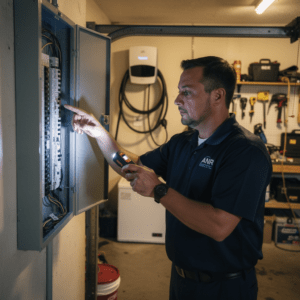
A licensed electrician can identify and repair bad connections. This might involve:
- Tightening connections at outlets, switches, and the panel ($100-$300)
- Replacing corroded outlets or switches ($75-$150 each)
- Cleaning and re-seating breakers ($150-$400)
- Addressing aluminum wiring connections ($3,000-$8,000 for whole home)
Potential Savings: $15-$40 per month depending on severity
2. Outdated, Energy-Wasting Lighting Circuits
How It Wastes Money:
If your home was built before 2000, you probably still have lighting circuits designed for incandescent bulbs drawing significant power. Even if you’ve switched to LEDs, the circuit itself may be wasting energy.
Here’s why: Older lighting circuits often have:
- Loose connections from decades of use
- Outdated switches that draw phantom power
- Poor wiring that creates resistance
- Dimmer switches incompatible with LED bulbs
The Dimmer Problem:
Old dimmer switches were designed for incandescent bulbs. When you use them with LED bulbs, they can:
- Cause LEDs to flicker or hum
- Draw more power than necessary
- Damage LED bulbs, requiring frequent replacement
- Generate heat that wastes energy
Warning Signs:
- LED bulbs flicker or buzz when dimmed
- LED bulbs burn out quickly (they should last years)
- Switches feel warm to the touch
- You can’t dim LEDs as low as you’d like
The Fix:
Upgrade to LED-compatible dimmer switches ($25-$50 per switch, installed). Replace old standard switches showing signs of wear ($75-$100 each, installed). Consider smart switches that allow scheduling and remote control ($100-$150 per switch, installed).
For homes with extensive lighting, a whole-home lighting circuit upgrade runs $800-$2,000 but can reduce lighting costs by 15-25%.
Potential Savings: $5-$20 per month
3. Phantom Power Loads and “Vampire” Devices
How It Wastes Money:
“Phantom loads” are devices that draw power even when turned off or in standby mode. Your TV, cable box, computer, microwave, coffee maker, and dozens of other devices are quietly sipping electricity 24/7.
But here’s the electrical problem most people don’t know about: Outdated outlets and circuits make phantom loads worse.
Old outlets with poor connections create resistance, which means devices have to draw MORE power to maintain their standby functions. Modern outlets with proper grounding and tight connections are significantly more efficient.
The Biggest Offenders:
- Cable/satellite boxes: 20-45 watts continuously
- Gaming consoles: 10-15 watts when “off”
- Desktop computers: 5-20 watts when “off”
- Laptop chargers: 2-5 watts when not charging
- Microwave clocks: 2-4 watts continuously
- TVs: 5-15 watts when “off”
- Phone/tablet chargers: 0.5-2 watts when not charging
Add it up across 20-30 devices, and you’re wasting 200-400 watts continuously—that’s $20-$40 per month.
The Electrical Connection:
While you can’t eliminate phantom loads entirely (and unplugging everything is impractical), upgrading old outlets improves electrical efficiency. Worn outlets with loose connections can increase phantom loads by 15-30%.
The Fix:
Electrical upgrades:
- Replace old, worn outlets: $75-$150 each, installed
- Install smart outlets with scheduling: $100-$200 per outlet, installed
- Add switched outlets so devices can be truly turned off: $150-$250 per outlet, installed
Non-electrical solutions:
- Smart power strips that cut power when devices are off: $25-$50 each
- Unplug chargers when not in use
- Enable power-saving modes on computers and TVs
Potential Savings: $15-$35 per month
4. Inefficient Electric Water Heater Without Proper Circuit
How It Wastes Money:
If you have an electric water heater (and you’re not on gas), it’s likely your single biggest electricity user—accounting for 14-18% of your total electric bill.
But here’s what many Akron homeowners don’t realize: An improperly wired water heater circuit can waste 10-20% more energy than necessary.
Common Water Heater Electrical Problems:
Undersized wire: Many older homes have water heaters on circuits with wire that’s too small for the load. This creates resistance and heat, wasting energy.
Poor connections: The connection at the breaker, at the water heater itself, or at any junction box creates resistance that wastes electricity and shortens the water heater’s lifespan.
Wrong voltage: If a 240V water heater is connected to 208V (common in some older homes), it will draw more amperage to produce the same heat, wasting energy and stressing the circuit.
No timer or smart control: Water heaters run 24/7, heating water you’re not using. Without proper controls, you’re paying to keep 40-50 gallons of water hot at 3am when everyone’s asleep.
Warning Signs:
- Water heater breaker trips occasionally
- Water heater seems to run constantly
- Water isn’t as hot as it used to be
- Breaker or connections at water heater feel warm
- Higher bills in winter when the water heater works harder
The Fix:
Electrical improvements:
- Verify proper wire size and upgrade if needed: $400-$800
- Repair poor connections at breaker and water heater: $150-$300
- Install dedicated circuit if water heater shares with other loads: $500-$1,000
Efficiency upgrades:
- Install timer to reduce running time: $150-$300, installed
- Add insulation blanket to reduce heat loss: $30-$50 DIY
- Lower temperature from 140°F to 120°F: Free (but verify it’s electrically efficient)
Consider: Modern heat pump water heaters use 60% less electricity but require proper electrical circuit installation and usually 200-amp service.
Potential Savings: $20-$50 per month
5. Overloaded Circuits Making Appliances Work Harder
How It Wastes Money:
When too many devices share a circuit, voltage drops. Appliances designed to run on 120 volts might only receive 110-115 volts. To compensate and deliver the same performance, they draw more amperage—using more electricity to do the same work.
It’s like trying to drink through a narrow straw—you have to suck harder (use more energy) to get the same amount.
Where This Happens:
Kitchen circuits: Refrigerator, microwave, coffee maker, toaster, and other appliances all on one or two circuits
Home office circuits: Computer, monitors, printer, desk lamp, phone charger, and router on one circuit
Entertainment centers: TV, cable box, gaming console, sound system, streaming devices all plugged into one outlet
Laundry areas: Washer and dryer on the same circuit (they should have separate dedicated circuits)
Warning Signs:
- Lights dim when certain appliances turn on
- Appliances seem less powerful than they should be
- Circuit breakers trip when running multiple devices
- You’ve plugged power strips into power strips
- Extension cords are used as permanent solutions
The Fix:
Add dedicated circuits for major appliances:
- Kitchen appliance circuits: $300-$600 per circuit
- Home office dedicated circuit: $400-$700
- Entertainment center circuit: $300-$500
- Separate washer and dryer circuits: $600-$1,200
For homes needing 3-5 new circuits, expect to spend $2,000-$4,000. This investment pays for itself through lower bills and longer appliance life.
Potential Savings: $10-$25 per month
6. Undersized Electrical Service Causing Inefficiency
How It Wastes Money:
If your home has 60-amp or even 100-amp electrical service, you’re probably running close to capacity much of the time. When electrical systems operate near their limits, efficiency drops dramatically.
Think of it like your car’s engine: Running at 90% capacity constantly uses more fuel per mile than running at 60% capacity.
The 80% Rule:
Electrical systems shouldn’t be loaded beyond 80% of their capacity for sustained use. With 100-amp service, you have only 80 amps of usable capacity. A typical modern home easily exceeds this:
- Central A/C: 15-20 amps
- Electric water heater: 18-25 amps
- Refrigerator: 6-8 amps
- Electric range: 40-50 amps
- Dryer: 20-30 amps
- Dishwasher: 10-12 amps
- Microwave: 10-12 amps
- Lighting and other loads: 15-25 amps
You’re already over capacity—and that’s before computers, TVs, chargers, and everything else.
How This Wastes Money:
When systems operate at the edge of capacity:
- Voltage drops, making appliances work harder
- Connections heat up, creating resistance
- Your electrical meter runs faster (you pay more for the same power)
- Appliances suffer increased wear and fail sooner
Warning Signs:
- Main breaker is 100-amp or smaller
- Frequent voltage drops (dimming lights)
- You consciously avoid running multiple appliances simultaneously
- Heavy reliance on space heaters because you can’t run central heat at full capacity
The Fix:
Upgrade to 200-amp service: $2,500-$5,000. This provides plenty of capacity for modern use and eliminates the inefficiency of operating near limits.
While expensive upfront, service upgrades typically pay for themselves in 3-5 years through lower bills, longer appliance life, and increased home value.
Potential Savings: $25-$60 per month
7. Air Conditioning and HVAC Electrical Issues
How It Wastes Money:
Your air conditioning system is typically your biggest electricity consumer in summer—sometimes accounting for 30-50% of your summer electric bill. Any electrical problem affecting your A/C creates massive waste.
Common A/C Electrical Problems:
Loose or corroded connections: At the disconnect box, at the condensing unit, or at the breaker. These create resistance that makes the compressor work harder.
Wrong wire size: If your A/C was upgraded but the circuit wasn’t, undersized wiring creates voltage drop and efficiency loss.
Shared circuits: A/C systems should ALWAYS have dedicated circuits. If yours shares with other loads, efficiency suffers.
Damaged capacitors: While technically not wiring, failing capacitors (which are electrical components) make compressors work harder and draw more power.
Poor outdoor unit electrical connections: Moisture and corrosion at outdoor connections create major efficiency losses.
Warning Signs:
- A/C seems to run constantly without cooling effectively
- Electric bills spike dramatically in summer
- A/C breaker trips occasionally
- Outdoor unit makes humming sounds
- Ice buildup on A/C lines
The Fix:
Electrical repairs:
- Tighten and clean all A/C electrical connections: $150-$300
- Upgrade undersized A/C circuit wiring: $500-$1,200
- Install dedicated circuit if needed: $600-$1,200
- Replace disconnect box and connections: $200-$400
Efficiency upgrades:
- Replace aging capacitors: $150-$400
- Install programmable thermostat: $200-$400, installed
- Ensure proper voltage supply: included in repairs above
For homes with heat pumps (heating and cooling), proper electrical supply is even more critical for efficiency.
Potential Savings: $30-$80 per month during cooling season
8. Old, Inefficient Electrical Panel Creating System-Wide Waste
How It Wastes Money:
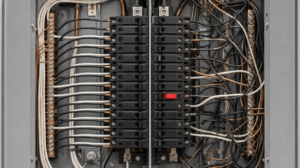
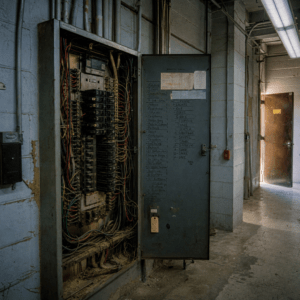
Your electrical panel is the heart of your home’s electrical system. An old, corroded, or inefficient panel creates resistance and heat that wastes electricity across your entire home.
How Panels Waste Energy:
Corroded bus bars: The metal bars that distribute electricity inside the panel can corrode over time, creating resistance.
Loose breaker connections: Breakers that aren’t firmly seated create resistance at one of the most critical connection points in your home.
Outdated panel design: Panels from the 1960s-1980s are simply less efficient than modern panels.
Overloaded panels: Panels filled to capacity with no room for expansion create voltage drops and inefficiency.
Federal Pacific/Zinsco panels: These hazardous panels are also notably inefficient due to poor internal connections.
Warning Signs:
- Panel feels warm or hot to the touch
- Rust or corrosion visible inside the panel
- Some breakers feel loose
- Breakers are hard to reset or don’t stay reset
- Your panel is 40+ years old
The Fix:
Electrical panel replacement: $1,500-$4,000. While expensive, a new panel:
- Improves efficiency across your entire electrical system
- Eliminates safety hazards
- Increases home value
- Provides capacity for modern needs
Modern panels are significantly more efficient than panels from the 1960s-1980s. Many homeowners see noticeable bill reductions after panel replacement, beyond the efficiency gains from addressing other issues.
Potential Savings: $15-$40 per month
Adding It All Up: Your Potential Savings
If your Akron home has multiple electrical efficiency problems, you could be wasting $100-$250 per month—that’s $1,200-$3,000 annually.
Conservative Example:
- Bad connections: $20/month
- Outdated lighting circuits: $10/month
- Phantom loads from old outlets: $15/month
- Water heater circuit issues: $25/month
- Overloaded circuits: $15/month
- A/C electrical problems: $40/month (summer)
Total waste: $125/month or $1,100/year (accounting for seasonal variations)
Investing $3,000-$6,000 in electrical repairs and upgrades pays for itself in 3-5 years through lower bills alone—and that’s before considering increased home value, longer appliance life, and improved safety.
The Electrical Efficiency Audit: Where to Start
Not sure which problems your home has? Consider a professional electrical efficiency audit:
What’s Included:
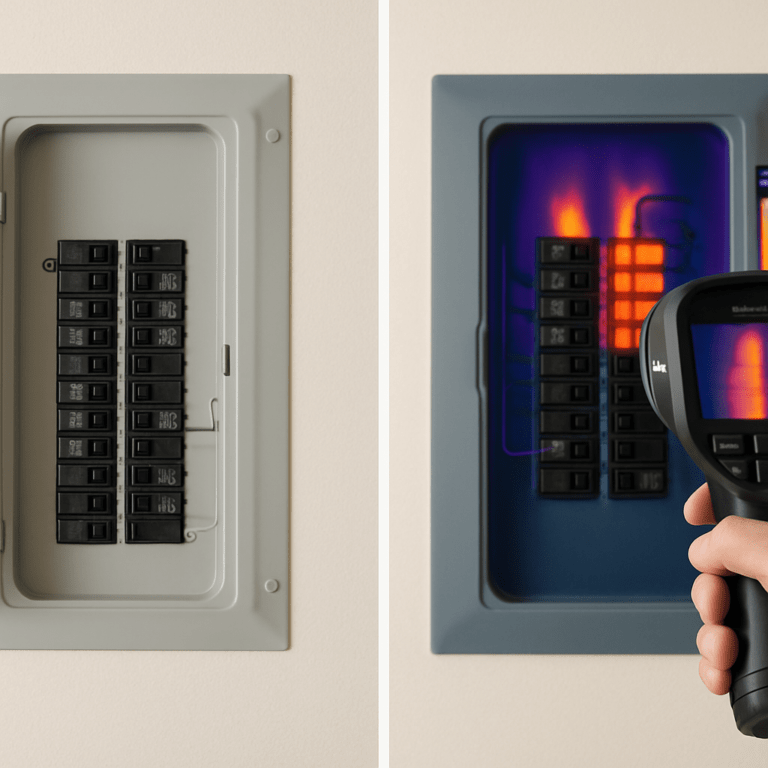
- Thermal imaging to identify hot spots and bad connections
- Voltage testing at outlets throughout the home
- Load analysis of your electrical panel
- Inspection of all major appliance circuits
- Identification of phantom loads
- Assessment of panel condition
- Prioritized list of efficiency improvements
Cost: $150-$400 for a thorough audit
Return: Audits typically identify $50-$200 in monthly waste, paying for themselves immediately.
DIY Electrical Efficiency Checks
Before calling an electrician, you can identify some issues yourself:
Check your outlets:
- Do any feel warm when nothing is plugged in? Problem.
- Are any loose or wobbly? Problem.
- Do plugs fall out easily? Problem.
Check your lighting:
- Do LEDs flicker with dimmer switches? Problem.
- Do LED bulbs burn out in months instead of years? Problem.
- Do switches feel warm? Problem.
Check your panel:
- Does it feel warm? Problem.
- Are any breakers loose or hard to reset? Problem.
- Do you hear humming or buzzing? Problem.
Monitor your bill:
- Compare usage year-over-year (not just dollar amounts)
- Look for unexplained increases
- Check if bills spike during specific seasons
If you find any of these issues, schedule an electrical inspection.
Northeast Ohio Energy Rates: Context for Your Bill
Understanding FirstEnergy rates helps put your bill in perspective:
Typical Akron Residential Rates (2024-2025):
- Average: $0.12-$0.15 per kWh
- Distribution charges: $0.03-$0.05 per kWh
- Transmission charges: $0.02-$0.03 per kWh
- Supplier charges: $0.07-$0.09 per kWh
Average Akron Home Usage:
- Summer: 900-1,200 kWh/month
- Winter: 700-1,000 kWh/month
- Spring/Fall: 500-800 kWh/month
Typical Monthly Bills:
- Summer: $135-$180
- Winter: $105-$150
- Spring/Fall: $75-$120
If your bills significantly exceed these ranges and you’re not running unusual equipment, electrical problems are likely contributing.
When to Call a Professional vs. DIY Solutions
DIY is appropriate for:
- Replacing standard switches with LED-compatible versions
- Installing smart power strips
- Unplugging phantom load devices
- Lowering water heater temperature
- Adding outlet-level timers
Call a professional for:
- Anything involving the electrical panel
- Adding or upgrading circuits
- Addressing warm/hot outlets or switches
- Repairing bad connections
- Installing dedicated appliance circuits
- Any work requiring permits
Never attempt DIY electrical work if:
- You smell burning
- You see sparks
- You don’t understand what you’re doing
- It involves the main panel
- It requires working with the meter
Electrical work can be fatal. When in doubt, hire a licensed electrician.
Professional Electrical Efficiency Services in Akron
At ANR Electric, we’ve been helping Akron homeowners reduce their electric bills through electrical efficiency improvements since 2011. We understand which electrical problems waste the most money and how to fix them affordably.
Our Energy-Saving Electrical Services:
- Comprehensive electrical efficiency audits
- Thermal imaging to identify problem areas
- Bad connection identification and repair
- Circuit optimization and load balancing
- Electrical panel upgrades for efficiency
- Dedicated circuit installation for major appliances
- Smart home electrical integration
- Complete residential electrical services
Our Approach:
We prioritize improvements by return on investment—addressing the problems that will save you the most money first. Not every home needs every upgrade. We help you focus your investment where it matters most for your specific situation.
Don’t keep throwing money at high electric bills without addressing the root causes. Electrical efficiency improvements pay for themselves and keep paying dividends for years.
Contact ANR Electric today at (330) 644-4454 or request an electrical efficiency audit online.
Key Takeaways: Reducing Your Electric Bill Through Electrical Fixes
✅ Bad electrical connections waste significant energy – Resistance from loose or corroded connections shows up as heat and higher bills
✅ Old outlets and circuits reduce efficiency – Even with LED bulbs, outdated circuits can waste 15-25% more energy
✅ Phantom loads are worse with old electrical systems – Worn outlets with poor connections increase standby power consumption
✅ Water heaters need properly sized circuits – Undersized wiring makes your water heater work harder and waste energy
✅ Overloaded circuits reduce appliance efficiency – Voltage drops force appliances to draw more power for same performance
✅ Undersized electrical service creates system-wide waste – Operating near capacity reduces efficiency across your entire home
✅ A/C electrical problems cause huge summer bill spikes – Bad connections and wrong wire sizes make cooling cost 20-30% more
✅ Old electrical panels waste energy throughout your home – Corroded connections and outdated designs reduce whole-home efficiency
✅ Multiple small problems add up to big waste – Fixing several electrical issues can save $100-$250/month
✅ Professional audits identify hidden problems – Thermal imaging and testing reveal issues you can’t see
Frequently Asked Questions About High Electric Bills and Electrical Problems
Can faulty wiring really make my electric bill higher?
Yes, absolutely. Loose connections, corroded wires, and bad connections create electrical resistance. Resistance generates heat—which is wasted electricity you’re paying for. Bad connections also cause voltage drops, forcing appliances to work harder and draw more amperage to deliver the same performance. Depending on severity, faulty wiring can waste 10-30% of your electricity, costing $20-$80 monthly in a typical Akron home.
How much can I save by upgrading my electrical panel?
Upgrading from an old, corroded panel to a modern 200-amp panel can save $15-$40 per month through improved efficiency across your entire electrical system. Modern panels have better connections, higher-quality components, and more efficient designs. While the upfront cost is $1,500-$4,000, the monthly savings plus increased appliance lifespan and home value make this upgrade worthwhile. The safety benefits are even more valuable than the cost savings.
Do old outlets really waste electricity?
Yes, but not in the way most people think. Old, worn outlets with loose connections create resistance that wastes small amounts of electricity directly. More significantly, they reduce the efficiency of everything you plug into them. Devices and appliances connected to old outlets can use 5-15% more electricity than the same items on new, tight-connection outlets. Replace outlets that are 20+ years old or show any signs of looseness.
Is my high electric bill caused by my neighbors stealing power?
Extremely unlikely. Power theft would require someone physically connecting to your meter or wiring before it enters your home—which is dangerous, difficult, and easily detected. If your bill seems wrong, the culprits are almost always: electrical problems in your home, malfunctioning appliances, phantom loads, inefficient systems, or meter inaccuracies. Contact FirstEnergy if you suspect meter problems—they’ll test it for free.
Should I get an electrical audit or an energy audit?
Different purposes. An energy audit (often offered by utilities) focuses on insulation, windows, HVAC efficiency, and weatherization. An electrical audit specifically examines your electrical system for problems, bad connections, and inefficiencies. If your bills are high but your insulation and HVAC are good, an electrical audit is more valuable. Many electricians include electrical efficiency assessment with whole-home electrical inspections for $150-$300.
How do I know if my electric water heater is wasting money?
Signs include: constantly running (you hear it heating frequently), circuit breaker feels warm, water heater takes long time to heat water, higher bills that spike in winter, or the unit is over 10 years old. Have an electrician verify proper wire size, check all connections, and measure voltage at the water heater. Even if the water heater itself is fine, electrical problems in the circuit can waste 10-20% of the energy it uses.
Can overloaded circuits damage my appliances?
Yes. When circuits are overloaded, voltage drops. Appliances designed for 120V might only receive 110-115V. Motors (in refrigerators, A/C, washers) compensate by drawing more current, running hotter, and wearing out faster. This is called “brown-out” conditions, and it significantly shortens appliance lifespan. The cost of replacing a refrigerator or A/C compressor prematurely far exceeds the cost of adding proper dedicated circuits.
What’s the fastest way to reduce my electric bill?
For immediate savings: identify and unplug phantom loads, lower water heater temperature to 120°F, and use programmable thermostats. For long-term savings: fix bad electrical connections ($200-$600), upgrade major appliance circuits ($500-$1,500), and address any hot outlets or switches immediately. Professional thermal imaging ($150-$300) quickly identifies the biggest problems. Most homeowners see ROI within 6-18 months.
Does FirstEnergy offer rebates for electrical upgrades?
FirstEnergy occasionally offers rebates for energy-efficient upgrades, but these typically focus on HVAC systems, insulation, and appliances rather than electrical wiring improvements. However, the Inflation Reduction Act provides tax credits for certain electrical upgrades related to efficiency improvements and EV charger installation. Check current programs—requirements and availability change. Even without rebates, electrical efficiency improvements pay for themselves through lower bills.
How much should I budget for electrical efficiency improvements?
For homes with minor issues: $500-$1,500 addresses most problems. For homes with moderate issues: $2,000-$4,000 covers circuit upgrades, connection repairs, and efficiency improvements. For homes with major issues: $5,000-$10,000 includes panel replacement, service upgrade, multiple circuit additions, and comprehensive fixes. Most Akron homeowners spend $2,000-$5,000 and see payback within 2-4 years through lower bills, longer appliance life, and increased home value.
Additional Resources
For more information about reducing your energy costs and understanding your electricity usage, visit the U.S. Department of Energy’s Energy Saver Guide, which provides comprehensive resources on home energy efficiency.
This article provides general information about electrical problems that increase electricity costs. Every home’s situation is unique and requires professional assessment by a licensed electrician. ANR Electric serves Akron, Canton, Cuyahoga Falls, Hudson, Stow, and surrounding communities throughout Northeast Ohio.