
There’s nothing more frustrating than walking down to your basement, resetting the same breaker for the third time this week, and wondering whether something is seriously wrong with your home.
Here’s the truth: a circuit breaker that trips once in a while is doing exactly what it was designed to do. But a breaker that trips repeatedly – especially when you’re just running everyday appliances – is telling you something. And it’s worth listening.
At ANR Electric, we get calls about tripping breakers from homeowners across Akron, Fairlawn, Stow, and the rest of Northeast Ohio on a regular basis. This guide breaks down the most common reasons it happens, what’s safe to handle yourself, and when it’s time to call a licensed electrician.
What Does a Circuit Breaker Actually Do?
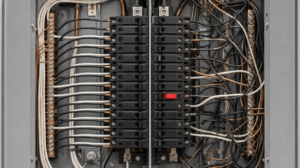
Think of your circuit breaker as a traffic cop for electricity. It monitors the flow of power through each circuit in your home, and when too much electricity tries to flow at once – or when something goes wrong – it shuts that circuit down automatically.
That “trip” isn’t a malfunction. It’s the breaker protecting your home from overheating wires, damaged appliances, and potentially, a house fire.
The problem is when the same breaker keeps tripping over and over. That’s a pattern, and patterns have causes.
The 5 Most Common Reasons Your Breaker Keeps Tripping
1. You’re Overloading the Circuit
This is by far the most common cause. Every circuit in your home has a limit – typically 15 or 20 amps – and when you plug in more than it can handle, the breaker trips.
This shows up most often in:
- Kitchens, where multiple high-draw appliances compete for the same outlet
- Bathrooms with hair dryers or space heaters
- Home offices where power strips are loaded with devices
- Living rooms where entertainment systems, gaming consoles, and lamps all share one circuit
If your breaker trips when you run the microwave and the coffee maker at the same time, that’s a classic overload. The fix is spreading your usage across different circuits – or adding dedicated circuits if your home doesn’t have enough.
2. You Have a Short Circuit
A short circuit is a more serious situation. It happens when a hot wire (the wire carrying electrical current) touches a neutral wire somewhere in the circuit – inside an outlet, a switch, an appliance, or behind your walls.
Signs of a short circuit include:
- A burning smell near an outlet or switch
- Visible scorch marks or discoloration on an outlet
- A loud pop or snap when the breaker trips
Short circuits need professional attention. Don’t keep resetting a breaker if you smell burning or see scorching.
3. You Have a Ground Fault
A ground fault is similar to a short circuit, but it happens when a hot wire touches a grounded surface – like the metal box of an outlet or even a damp wall. Ground faults are especially common in bathrooms, kitchens, and garages where moisture is present.
GFCI outlets are specifically designed to detect ground faults and cut power in milliseconds, before you get hurt. If your breaker is tripping in a moisture-prone area of your home, a ground fault could be the cause.
4. The Breaker Itself Is Worn Out
Circuit breakers aren’t meant to last forever. Most are designed to handle a limited number of trips before they start to weaken. An aging breaker might trip easily even when the electrical load is perfectly normal – or it may stop tripping when it should, which is actually more dangerous.
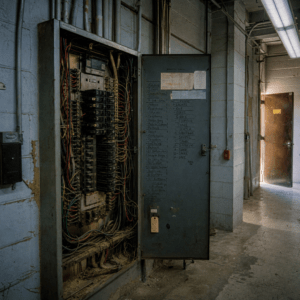
If your home still has an older panel – especially a Federal Pacific or Zinsco panel – you have additional reason for concern. These brands have well-documented reliability issues.
5. Your Home’s Electrical System Is Outdated for Modern Demand
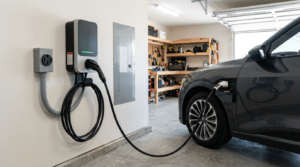
Homes built before the 1990s were designed for a very different world. A 100-amp panel was plenty when the average home had a refrigerator, a few lights, and a TV. Today, that same home might have an EV charger, multiple home offices, central air conditioning, and a tankless water heater all competing for power.
When your panel can’t keep up with modern demand, overloading becomes a constant battle – and breakers trip regularly as a result. Our team performs panel upgrades throughout Summit County, Portage County, and surrounding areas.
Is It Safe to Just Keep Resetting the Breaker?
Resetting a tripped breaker is fine when you know what caused it – like unplugging a few appliances before flipping it back. The reset itself is safe.
What’s not safe is resetting a breaker over and over when you don’t know why it’s tripping. If you can’t identify the cause, or if it trips again immediately after you reset it, stop and call a licensed electrician. Repeatedly forcing power through a troubled circuit can damage wiring, damage appliances, and in the worst cases, cause a fire inside your walls.
According to the Electrical Safety Foundation International, electrical fires cause more than 1,400 injuries and roughly 500 deaths in the U.S. each year – and many of them start inside walls, long before anyone notices a problem.
What to Do Before You Call an Electrician
When a breaker trips, here’s a quick process to run through before picking up the phone:
- Unplug everything on that circuit before resetting
- Reset the breaker once – flip it fully to “OFF” first, then back to “ON”
- Plug things back in one at a time to identify if a specific appliance is causing the issue
- Check for visible damage – scorching, melting, or burning smells near any outlets
- Make note of the pattern – does it trip at a certain time of day? Only when a specific appliance is running? This information is helpful for your electrician.
If the breaker trips again with nothing plugged in, or if you notice any burning smell or scorch marks, call us. That’s not a DIY situation.
When ANR Electric Can Help
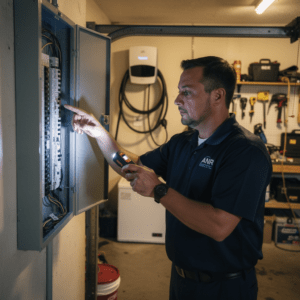
Our licensed electricians serve homeowners throughout Akron, Stow, Cuyahoga Falls, Hudson, Barberton, and the surrounding communities. Whether you need a dedicated circuit added for your home office, a panel assessment, or a full electrical inspection, we’ll give you a straight answer about what’s going on – and what it takes to fix it.
There’s no guessing, no upselling, and no leaving you with more questions than you started with. Contact ANR Electric to schedule an assessment: anrelectricco.com/contact-us
Frequently Asked Questions
Why does my circuit breaker keep tripping with nothing plugged in?
If your breaker trips even when nothing is drawing power from it, the problem is likely inside the circuit itself – a damaged wire, a failing breaker, or a fault somewhere behind your walls. This is not something to reset repeatedly. It warrants a call to a licensed electrician who can safely trace the source.
Is it dangerous if a circuit breaker keeps tripping?
An occasional trip is normal and safe – that’s the breaker doing its job. Repeated tripping on the same circuit is a warning sign. It typically means there’s an ongoing issue (overload, short circuit, or wiring fault) that will get worse over time if left unaddressed. It can become dangerous if ignored.
How do I fix a circuit breaker that keeps tripping?
Start by unplugging everything on that circuit, then reset it. If it holds, add devices back one at a time to find the culprit. If it trips immediately with nothing plugged in, or if you notice any burning smell or scorch marks, call a licensed electrician. Don’t continue resetting it.
Can a bad outlet cause a breaker to trip?
Yes. A damaged, worn, or improperly wired outlet can cause a ground fault or short circuit that trips the breaker. If the tripping always seems to start when you use a specific outlet, that outlet is worth inspecting.
Why does my breaker trip when I turn on my air conditioner, microwave, or hair dryer?
These are all high-draw appliances that pull a significant amount of power in a short burst. If they’re sharing a circuit with other devices, the total load can exceed the circuit’s limit. The solution is usually a dedicated circuit – a circuit wired exclusively to that one appliance.
How many times can a circuit breaker trip before it needs to be replaced?
There’s no hard rule, but breakers are mechanical devices and they wear out over time. Most are rated for a limited number of operations. If your breaker trips frequently or no longer resets cleanly, it may need replacement. A licensed electrician can test it.
Why does my breaker trip at night or during certain times of day?
This often points to a pattern in your power usage – perhaps a high-draw appliance that runs on a timer (like an HVAC system, water heater, or dehumidifier) that’s competing with other loads. Time-of-day patterns are useful diagnostic clues, so note them before calling your electrician.
Should I be worried if my breaker trips often but always resets fine?
Yes – easy resets can give a false sense of security. If the underlying cause is a wiring fault, a worn breaker, or chronic overloading, the damage accumulates over time even when the breaker resets easily. Persistent tripping is always worth having looked at by a professional.