You bought the car. It came with a cord that plugs into a regular wall outlet. And now, three weeks in, you have done the math on that cord and realized it adds about four miles of range per hour, which means a full charge takes roughly two days.
That is the moment most Northeast Ohio drivers start pricing out a real EV charger installation. Here is what nobody tells you up front about EV charger installation: the charger itself is the cheap part. The wire, the breaker, the panel capacity, and the permit are what actually determine your number. Two houses on the same street in Ellet can get quotes $2,000 apart, and both quotes can be honest.
At ANR Electric, we have been wiring homes and businesses across Akron since 2011, and EV charger installation has gone from a novelty request to a weekly one. This guide walks through what the work actually involves, what it costs in 2026, why the federal tax credit is no longer part of the conversation, and how to tell whether your panel is ready before anyone shows up with a quote.
What a Level 2 EV Charger Installation Actually Needs
The cord that came with your car is a Level 1 charger. It runs on a standard 120-volt outlet and delivers three to five miles of range per hour. Fine for a plug-in hybrid. Not fine for a 300-mile battery.
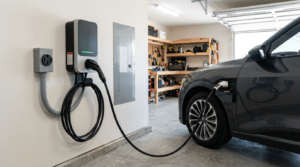
A Level 2 charger runs on 240 volts, the same voltage that feeds your dryer or range, and delivers roughly 20 to 30 miles of range per hour. Plug in at 9 p.m., wake up full. That is the whole point.
To get there, a proper EV charger installation needs three things:
- A dedicated 240-volt circuit. Most Level 2 units call for a 40-amp or 50-amp breaker. Under the National Electrical Code, a charger drawing continuous current has to be sized at 125 percent of its load, so a 48-amp charger needs a 60-amp circuit. This circuit serves the charger and nothing else. If you are unfamiliar with why that matters, our guide to dedicated circuits in Akron homes breaks it down.
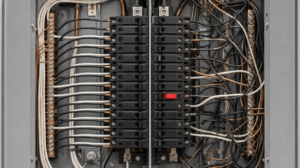
- Panel capacity to spare. Your service has a fixed ceiling. A 100-amp panel feeding a house with electric water heating, central air, and a range may simply not have 50 amps left to give.
- A permit and an inspection. In Ohio this is not optional, and we will get to it below.
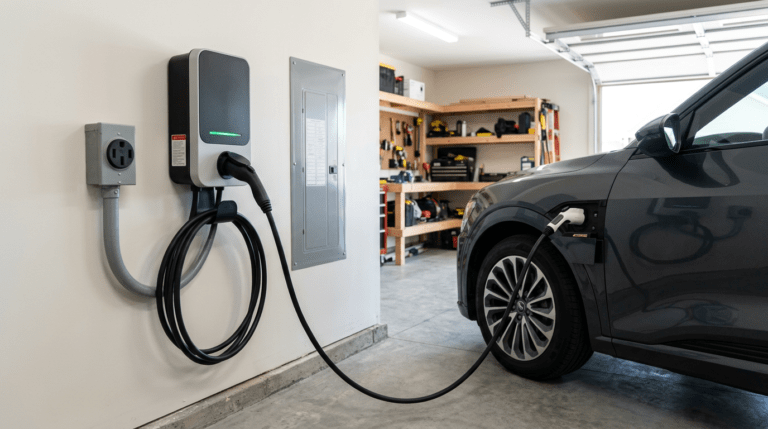
Hardwired or plug-in? Hardwiring is the more durable choice for a permanent charger and is required for units above 48 amps. A NEMA 14-50 receptacle gives you flexibility to swap chargers later, but the receptacle itself becomes a wear item and needs to be a quality industrial-grade unit, not a $12 builder-grade one. We have replaced burned 14-50 outlets that were installed correctly but were simply cheap.
What EV Charger Installation Costs in Akron in 2026
Nationally, home EV charger installation runs anywhere from about $800 to $4,500 installed, hardware included. That range is uselessly wide until you know which of these three situations you are in.
Situation 1: The easy EV charger installation. Roughly $900 to $1,600.
Your panel is in the garage or on the other side of the garage wall. It has open breaker spaces and available capacity. The run is under 20 feet. This is a half-day job.
Situation 2: The long run. Roughly $1,600 to $3,000.
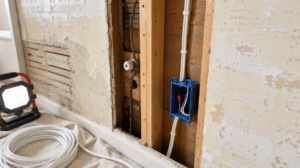
Your panel is in the basement on the opposite corner of the house from the garage. Now we are running 6-gauge or 4-gauge copper 60 to 100 feet, possibly through finished space, possibly in conduit along a foundation wall, possibly trenching to a detached garage. Copper is priced by the foot and the labor scales with the distance.
Situation 3: The panel is full or undersized. Roughly $2,800 to $6,000.
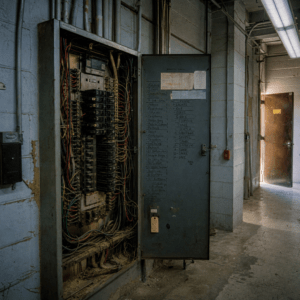
This is where an electrical panel upgrade enters the picture. If your home still has a 100-amp service, adding a 50-amp continuous load frequently pushes the calculated demand past what the service can carry. The fix is a 200-amp service upgrade, and the charger goes in afterward.
The EV charger installation cost drivers, ranked by how much they actually move the number:
- Distance from panel to charger location
- Whether the panel has capacity and open spaces
- Finished versus unfinished walls along the route
- Indoor garage versus outdoor or detached structure
- Charger hardware itself, typically $350 to $800 for a quality 48-amp unit
One note worth more than the rest: get the load calculation done before you buy the charger. We have walked into more than one Akron garage where a homeowner bought an 80-amp charger for a house that could support 32 amps. The box was already open. The receipt was already 40 days old.
The Federal Tax Credit Is Gone. Here Is What That Means.
This is the part of the conversation that changed in 2026, and a lot of the EV charger installation content still floating around online has not caught up.
The federal Alternative Fuel Vehicle Refueling Property Credit, known as 30C, gave homeowners 30 percent of the cost of a charger back, capped at $1,000, if the property sat in a qualifying census tract. It expired for property placed in service after June 30, 2026. The IRS page for the Alternative Fuel Vehicle Refueling Property Credit confirms the eligibility window ran from January 1, 2023 through June 30, 2026.
If your charger was energized on or before June 30, 2026, you can still claim it on Form 8911 when you file. If it goes in this fall, there is no federal credit to claim. Any contractor quoting you a price and telling you to “just take the $1,000 back on your taxes” is working from stale information, and that is worth knowing about them before you sign anything.
The commercial side lost the same credit. Businesses that were eligible for 6 percent of cost up to $100,000 per port, or 30 percent with prevailing wage and apprenticeship compliance, are subject to the same June 30, 2026 cutoff.
What is left? Utility-side programs change year to year, so it is worth calling Ohio Edison before you schedule. Some employers and multifamily property owners also have separate incentive paths. But plan your budget assuming the federal money is not coming, because it is not.
EV Charger Installation Permits and Who Issues Them in Akron
Ohio does not treat EV charger installation as appliance work. It is a new branch circuit, and a new branch circuit requires a permit.
Here is the part that trips people up: the City of Akron does not issue electrical permits. The City of Akron Plans and Permits office handles sewer, grading, right-of-way, and similar work. Electrical permits for projects inside Akron city limits go through the Summit County Department of Building Standards at 1030 East Tallmadge Avenue, which provides residential plan review and inspection services for 22 jurisdictions across the county.
Permit fees are set by the county and scale with the scope of the work, so the number on a single charger circuit is not the number on a whole-house rewire. On a residential EV charger installation the permit is a small share of the project. A licensed contractor should handle the application, the fee, the scheduling, and the administrative time behind all of it as part of the quote, rather than sending you to the counter yourself.
The work is inspected against the 2023 National Electrical Code, which Ohio adopts through the Ohio Residential Code. That inspection is not bureaucratic theater. It is the document that protects you when you sell the house and a buyer’s inspector asks who put in the 60-amp circuit in the garage.
Skipping the permit on an EV charger installation creates three specific problems: an unpermitted circuit can show up as a defect during a sale, an insurance carrier can contest a claim tied to unpermitted work, and any warranty on the charger hardware typically requires professional installation. Our post on electrical issues that kill home sales in Akron covers how this plays out at closing.
What EV Charger Installation Looks Like Start to Finish
A typical residential EV charger installation at ANR Electric runs like this:
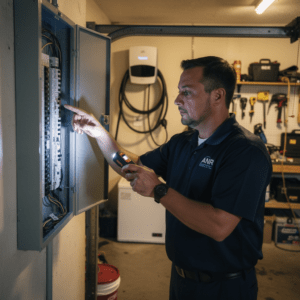
- Site visit and load calculation. We look at your panel, count your circuits, run the calculation, and confirm the charger you want is a charger your service can carry. This is where surprises get found, not on install day.
- Quote with the route drawn. You should see the proposed path, the wire gauge, the breaker size, and whether the price assumes a panel upgrade.
- Permit pulled. We file with Summit County. Typical turnaround for a straightforward residential electrical permit is a few business days.
- Installation. Straightforward jobs take four to six hours. Long runs, trenching, or panel work push into a second day.
- Inspection. The county inspector verifies the circuit, the breaker, the grounding, and the mounting.
- Commissioning. We energize, test under load, connect the unit to your Wi-Fi if it has an app, and confirm it is actually delivering rated amperage.
Total elapsed time for most EV charger installation jobs: one to two weeks from first call to first charge, and most of that is permit turnaround rather than labor.
What It Costs to Actually Charge in Northeast Ohio
Once the EV charger installation is finished, the running math is friendlier than most people expect.
The U.S. Energy Information Administration puts Ohio’s average residential retail electricity price at 15.99 cents per kilowatt-hour. A typical EV covers about 3.5 miles per kilowatt-hour. Drive 1,000 miles in a month and you use roughly 286 kilowatt-hours, or about $46 in electricity.
That same 1,000 miles in a 28-mpg gas vehicle is about 36 gallons. You can do that comparison yourself at whatever the sign says on Arlington Road this week.
Two things sharpen the number further. First, check whether your supplier offers a time-of-use rate, because charging at 1 a.m. instead of 6 p.m. can meaningfully cut the cost. Second, a hardwired charger with load management can share capacity with other large loads, which occasionally lets you avoid a service upgrade altogether. That is a load calculation question, not a guess.
Commercial and Multi-Unit EV Charger Installation
Businesses face a different problem. Residential EV charger installation is one circuit. Commercial is an infrastructure project.
A four-port installation at a Fairlawn office or a Hudson retail center involves a service capacity study, trenching and conduit across a parking area, concrete bollards, a subpanel or dedicated distribution, network connectivity for billing, and ADA-compliant stall layout. Load management hardware is usually the difference between a project that fits the existing service and one that requires a utility upgrade, and utility upgrades are where commercial EV timelines go from weeks to months.
ANR Electric handles commercial electrical work for parking facilities, hotels, healthcare campuses, and retail sites across Northeast Ohio, including the design, load study, and permitting side rather than just the terminations.
Frequently Asked Questions
How long does EV charger installation take?
Most residential installs take four to six hours of on-site work. If the panel has capacity and the run is short, it is a single-day job. Add a day for long conduit runs, trenching to a detached garage, or a panel upgrade. From your first call to your first charge, plan on one to two weeks, since permit turnaround usually takes longer than the labor.
Do I need a permit to install an EV charger in Akron?
Yes. A Level 2 charger is a new branch circuit and requires an electrical permit. In Akron, permits are issued by the Summit County Department of Building Standards, not the City of Akron. Fees are set by the county and scale with the scope of the work. Your licensed electrician should pull the permit, cover the filing, and schedule the inspection as part of the job.
Can I do an EV charger installation myself?
Ohio homeowners can pull their own permit for work on a home in their name with a notarized homeowner affidavit. That does not make it a good idea. A 240-volt, 50-amp circuit carries enough energy to start a structure fire if the conductor is undersized or a termination is loose, and a failed inspection means the work comes back out of the wall.
Will an EV charger overload my electrical panel?
It can. A 48-amp charger is a continuous load requiring a 60-amp breaker, which is a large addition to a 100-amp service. The only way to know is a load calculation that accounts for your service size, square footage, and existing large appliances. If capacity is short, the options are a service upgrade or a load-managed charger that throttles when other loads spike.
Is there still a tax credit for home EV chargers?
Not federally. The 30C Alternative Fuel Vehicle Refueling Property Credit expired for property placed in service after June 30, 2026. Chargers energized on or before that date can still be claimed on IRS Form 8911. Utility and employer programs change year to year, so check with Ohio Edison directly before assuming any incentive.
How much does it cost to charge an EV at home in Ohio?
At Ohio’s average residential rate of 15.99 cents per kilowatt-hour and roughly 3.5 miles per kilowatt-hour of efficiency, 1,000 miles of driving costs about $46 in electricity. Time-of-use rates that price overnight power lower can reduce that further.
Get a Straight Answer on Your Panel Before You Buy a Charger
Every EV charger installation question eventually comes back to the same one: does your service have the capacity? That takes a load calculation, not a guess, and it is the difference between a $1,200 job and a $4,500 one.
ANR Electric has been powering Akron homes and businesses since 2011. We will look at your panel, run the numbers, and tell you what your house can actually support before you spend a dollar on hardware.
Schedule your EV charger assessment
Or call us directly at (330) 644-4454. We serve Akron, Green, Hudson, Fairlawn, Macedonia, Richfield, Kent, Canton, Medina, Wooster, and Alliance, with 24-hour emergency service available.