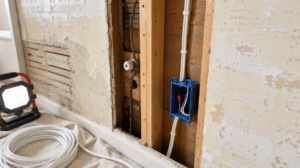
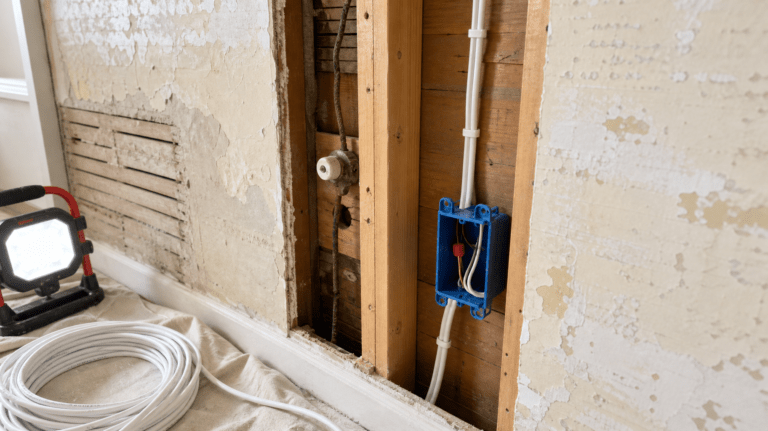
The bedroom outlet has two slots and no ground. There is one receptacle per wall, if that. The living room ceiling fixture is controlled by a switch that also, for reasons lost to history, controls a receptacle in the hallway.
If you own a house in Highland Square, West Hill, Goodyear Heights, Kenmore, or half of Cuyahoga Falls, you know this house. Northeast Ohio has some of the best old housing stock in the Midwest, and a lot of it is still running on wiring designed for a radio and three lamps.
Rewiring a house is the largest electrical project a homeowner ever takes on. It is also the one most surrounded by bad information, because the internet’s version assumes an empty 1970s ranch and yours is a full 1926 colonial with plaster walls and a finished third floor. This guide covers what rewiring a house actually costs in Northeast Ohio in 2026, how to tell whether you need a full rewire or a partial one, what the process looks like from the inside, and the specific signs that move this from “someday” to “this year.”
Does Rewiring a House Mean the Whole House?
Start here, because rewiring a house end to end is frequently unnecessary, and a good electrician will tell you so.
A full rewire is usually warranted when:
- The home has knob and tube wiring still in active service. K&T has no ground conductor, its insulation embrittles with age, and it was never designed to be buried in blown-in insulation, which many Akron homes had added in the 1970s and 1980s.
- The home has cloth-insulated NM cable where the insulation is cracking, flaking, or crumbling when a device is pulled.
- The home has aluminum branch circuit wiring from the mid-1960s through the mid-1970s. Whether a full rewire or an approved repair method is appropriate depends on the situation, and we cover the options in our guide to aluminum wiring in Northeast Ohio homes.
- Rodent damage is widespread. Mice chew insulation. If you find it in three places, it is in more.
- There is no equipment grounding conductor anywhere in the house and you want grounded receptacles throughout.
- The house is being gutted anyway. If plaster is coming down for a whole-house renovation, rewiring a house during demolition costs a fraction of what it costs after.
A partial rewire or targeted work is often enough when:
- Only the original portion of the house is problematic and additions were wired later to code
- The issue is confined to a specific area, like the kitchen or a single circuit
- The house has grounded NM cable in reasonable condition but insufficient circuits
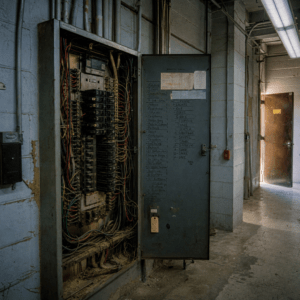
- The real problem is the panel, not the branch circuits, in which case an electrical panel upgrade solves it for a fraction of the price
How to actually find out. Pull three or four device covers in different parts of the house and different eras of construction, and look at what is behind them. Check the attic and the basement joists, where wiring is visible without opening anything. An honest electrician will do exactly this before quoting, and a rewire quote produced without it is a guess.
What Rewiring a House Costs in 2026
Cost data for rewiring a house lands in a fairly consistent range nationally, and Northeast Ohio labor rates put us in the middle of it rather than at the coastal high end.
The current Angi cost data for rewiring a house puts the work at $2 to $4 per square foot, with a typical 2,500 square foot home running $5,000 to $10,500 in materials and labor. Their size breakdown:
| Home size | Typical rewire cost |
|---|---|
| 1,000 sq. ft. | $2,000 to $4,000 |
| 1,500 sq. ft. | $3,000 to $6,000 |
| 2,000 sq. ft. | $4,000 to $8,000 |
| 2,500 sq. ft. | $5,000 to $10,000 |
| 3,000 sq. ft. | $6,000 to $12,000 |
Those numbers assume accessible walls. In practice, most Northeast Ohio rewires land at the top of the range or above, because our housing stock has three features that cost money: plaster and lath instead of drywall, balloon framing without accessible chases in some eras, and finished basements and attics that eliminate the two easiest paths to run cable.
Realistic all-in budgeting for rewiring a house in Akron’s older stock:
- Accessible, gutted, or unfinished: $2.50 to $4.00 per square foot
- Occupied home with plaster walls, fished: $5.00 to $8.00 per square foot
- Occupied home with finished basement and attic: $7.00 to $11.00 per square foot
Common additional line items, drawn from the same cost data:
- Permits and inspections: set by the county, plus your contractor’s filing and coordination time
- Wall opening and repair: $4 to $8 per square foot of opened surface
- New 200-amp panel: $1,500 to $2,500
- Electrician labor: $50 to $100 per hour
The one people forget: drywall and paint. Almost no electrical contractor includes finish repair. Fishing wire through plaster means cutting access holes, and a whole-house rewire in an occupied home can mean dozens of them. Get a separate plaster or drywall number before you set your budget, not after.
Warning Signs That Rewiring a House Cannot Wait
Some of these are inconveniences. Some of them are the reason rewiring a house moves to the top of the list this week.
Call now:
- Any burning smell with no source. Overheating conductors smell like hot plastic or fish. This is not a “monitor it” situation.
- Warm or discolored receptacles and switch plates. Heat at a device means a poor connection.
- Sparking when you plug something in. A small arc as contact is made can be normal. A visible spark, a pop, or a scorch mark is not.
- Buzzing from a wall, switch, or panel. That is arcing.
- Breakers tripping repeatedly on the same circuit. Our post on why circuit breakers keep tripping explains when this is normal and when it is not.
Plan for it:
- Two-prong ungrounded receptacles throughout. Every modern electronic device expects a ground.
- Lights dimming when the furnace or AC starts. Voltage drop under load points to undersized conductors or loose connections.
- Fewer than two receptacles per room. A sign the wiring predates the expectation that rooms contain electricity.
- Extension cords in permanent use. This is a symptom, and it is also an independent fire risk.
- Cloth-covered or fabric-sheathed cable visible in the basement.
- A home inspection report that flagged the wiring. If you are selling, deal with it before it becomes a negotiation. Our post on electrical issues that kill home sales in Akron covers what inspectors write up most.
The stakes here are documented. The National Fire Protection Association reports U.S. fire departments respond to an average of 35,150 home fires a year involving electrical distribution and lighting equipment, resulting in roughly 490 civilian deaths, 1,200 injuries, and $1.3 billion in direct property damage each year.
What the 2023 Code Requires When Rewiring a House
Rewiring a house is not a like-for-like replacement. New circuits are held to current code, and Ohio’s Residential Code incorporates the 2023 National Electrical Code. That means the rewired house has requirements the original house never had.
- AFCI protection on most habitable-room circuits. Arc-fault breakers cost several times what standard breakers cost, and a full rewire needs a panel full of them.
- GFCI protection in kitchens, bathrooms, garages, basements, laundry areas, outdoors, and near sinks. Our guide to GFCI outlet requirements for Akron homeowners covers exactly where.
- Tamper-resistant receptacles in dwelling unit locations.
- Receptacle spacing so that no point along a wall is more than six feet from an outlet, which in an old house usually means doubling or tripling the receptacle count.
- Dedicated small appliance branch circuits in the kitchen, plus dedicated circuits for the dishwasher, disposal, microwave, and refrigerator. Our post on dedicated circuits in Akron homes explains why these matter.
- Surge protection. NEC 230.67 requires a Type 1 or Type 2 surge protective device at dwelling unit services, and it applies where service equipment is replaced.
- Grounding and bonding to current standards, including the grounding electrode system and intersystem bonding.
This is why a rewire quote is not simply the old circuit count times a price. You are usually going from 12 circuits to 24 or more.
Rewiring a House, Week by Week
For rewiring a house of 1,800 square feet in Akron with plaster walls and a family still living in it, a realistic timeline:
Week 1: Assessment and permit. The electrician walks the house, opens devices, checks the attic and basement, counts circuits, and designs the new layout. Permit filed with the Summit County Department of Building Standards, which issues electrical permits for Akron rather than the city.
Week 2: Rough-in, first half. Crews work in zones so the house stays livable. Access holes are cut, new cable is fished from the attic and basement, boxes are set. Expect power off in the active zone during working hours.
Week 3: Rough-in, second half, and panel. Remaining zones plus the new panel and service work. The utility disconnects and reconnects for the service portion, meaning a full day without power.
Week 4: Rough inspection, then trim. The inspector verifies the work while boxes are still open. Then devices, plates, and fixtures go in and the panel directory is labeled.
Week 5: Final inspection, then finish repair. Drywall or plaster patching, prime, and paint follow the final inspection.
Living through it. Most families stay in the house. It is dusty, loud, and inconvenient rather than impossible. Plan around the day the service is swapped, keep a cooler ready, and expect furniture moved away from every exterior wall for the duration.
Rewiring a House You Are About to Buy
If you are under contract on an older Northeast Ohio home and the inspection flagged the wiring, you have leverage and a decision.
The leverage: a written rewire estimate from a licensed contractor is a stronger negotiating instrument than an inspector’s note. Get one during the inspection period.
The decision: rewiring a house is dramatically cheaper and faster before you move in. Empty rooms, no furniture, no scheduling around a family, and finish repair happens before you paint anyway. If a rewire is in the house’s near future, doing it in the two weeks between closing and move-in is the best money you will spend on the property.
The financing angle worth asking your lender about: renovation loan products exist that roll improvement costs into the mortgage. Whether one fits your situation is a question for your lender, not your electrician, but it is worth raising before you assume the work has to come out of savings.
Frequently Asked Questions
How much does rewiring a house cost in Northeast Ohio?
Published cost data puts whole-house rewiring at $2 to $4 per square foot, or roughly $5,000 to $10,500 for a 2,500 square foot home. Older Akron homes with plaster walls and finished basements typically land higher, in the $5 to $11 per square foot range, because the wiring has to be fished rather than run through open framing.
How long does rewiring a house take?
An occupied 1,800 square foot home with plaster walls typically takes four to five weeks from permit to final inspection, including inspection scheduling and finish repair. A vacant or gutted home of the same size can be done in one to two weeks. Crews normally work in zones so most of the house keeps power.
Do I have to move out while my house is rewired?
Usually no. Most families stay in the home. Electricians work zone by zone so power stays on in the areas not being worked, though you should expect at least one full day without power when the service and panel are changed. Expect dust, noise, and furniture pulled away from exterior walls.
Does homeowners insurance cover rewiring a house?
Generally no. Rewiring is treated as an upgrade or maintenance, not a covered loss, unless the damage came from a covered event such as a fire. What insurance does affect is coverage availability: some carriers decline to write policies on homes with active knob and tube or certain panel brands, which can make the rewire a condition of coverage.
Does rewiring a house mean tearing out the walls?
Mostly, yes. Experienced electricians fish new cable through wall cavities from the attic and basement, cutting small access holes at studs, corners, and box locations rather than opening entire walls. Some patching is unavoidable, particularly with plaster and lath, but a full demolition is rarely necessary in a home with accessible attic and basement space.
Is knob and tube wiring illegal in Ohio?
Existing knob and tube wiring is not automatically illegal, and it is generally allowed to remain where it is in good condition and undisturbed. It cannot be extended, and it should not be covered by insulation. In practice, insurers and lenders drive the timeline more than code does, since many will not write or approve a policy on a home with active knob and tube.
Find Out Whether You Need a Full Rewire or Half of One
The most expensive thing about rewiring a house is buying more of it than you need. Plenty of Northeast Ohio homes we look at turn out to need a panel, a kitchen circuit set, and a handful of grounded circuits rather than a whole-house rewire.
ANR Electric has been working in Akron’s older housing stock since 2011. We will open devices, check the attic and basement, tell you what era of wiring you actually have, and give you a written scope that separates what is urgent from what can wait.
Or call (330) 644-4454. We serve Akron, Green, Hudson, Fairlawn, Macedonia, Richfield, Kent, Canton, Medina, Wooster, and Alliance, with 24-hour emergency service. See all of our residential electrical services.